

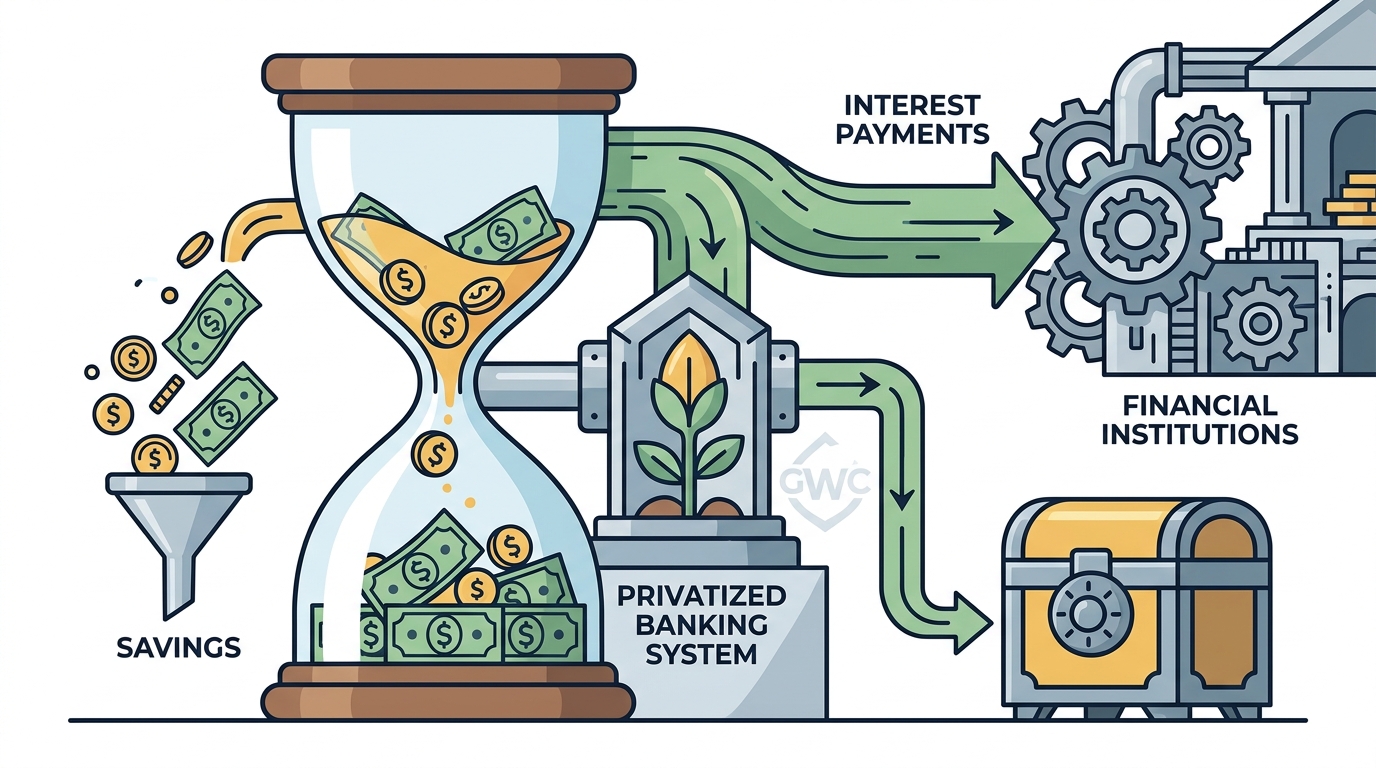
The average savings rate in America is currently only about 6% of earned income, while the average American spends around 34.5% on interest payments to financial institutions. This disparity creates a significant wealth gap that traditional banking models rarely address. By shifting from a consumer of financial products to the provider of your own capital, you can recapture that lost interest and build a self-sustaining financial engine. This guide details the precise methodology for establishing a Privatized Banking system, a strategy pioneered by Nelson Nash and now implemented by experts like Daniel Soto to help families achieve financial independence.
What is Privatized Banking?
Privatized Banking is a financial strategy that utilizes a dividend-paying whole life insurance policy to create a personal "bank" that you control. Unlike traditional banking where your deposits earn minimal interest while you pay high rates on debt, this system allows you to borrow against your own cash value. The core mechanism relies on the policy continuing to grow and accrue compound interest uninterrupted, even while you are using the funds for investments or major purchases.
This approach transforms you from a debtor into a lender. When you take a loan from your private bank, you are essentially paying interest to yourself rather than a third-party institution. This process is often referred to as "debt recapture," where you reclaim the interest you would have otherwise lost to banks, credit card companies, or mortgage lenders. The foundation of this system is a carefully engineered permanent life insurance policy designed to maximize cash value accumulation.
Step 1: Selecting the Right Insurance Vehicle
The first critical step in setting up a privatized banking system is selecting the correct insurance product. Not all life insurance policies are suitable for this strategy. You need a participating whole life insurance policy issued by a mutual insurance company. These policies offer guaranteed cash value growth and the potential to receive dividends, which can be used to purchase additional paid-up insurance or increase the cash value.
At Generational Wealth Concepts, we specialize in structuring these policies to align with your specific financial goals. The policy must be designed to maximize cash value in the early years while maintaining the flexibility to support collateral loans. This requires a deep understanding of insurance mechanics, including the difference between guaranteed values and projected non-guaranteed dividends. Working with a wealth coach who understands these nuances is essential to avoid underfunding or overfunding the policy.
Step 2: Strategic Funding and Cash Value Growth
Once the policy is selected, the next phase is strategic funding. This involves paying premiums into the policy to build cash value rapidly. The goal is to reach a point where the cash value is substantial enough to support meaningful loans without jeopardizing the policy's stability. This process requires discipline and a long-term perspective, as the benefits of privatized banking compound over time.
During this growth phase, it is crucial to avoid taking loans prematurely. The cash value needs time to establish a strong foundation. Think of this as planting a tree; you must allow the roots to grow deep before you can harvest the fruit. For those looking to accelerate this process, life insurance solutions can be tailored to fit your budget and income goals, ensuring that you are maximizing the efficiency of every premium dollar.
Step 3: Accessing Capital via Collateral Loans
When you need capital for a major purchase, such as a home, car, or business investment, you do not sell your assets or take a traditional loan. Instead, you take a collateral loan against your policy's cash value. This loan is secured by your own money, meaning the insurance company faces minimal risk. As a result, the approval process is typically fast, and the interest rates are often competitive.
One of the most powerful aspects of this step is that your cash value continues to grow as if the money were still fully deposited. You are not losing the compounding interest on the borrowed amount. This allows you to leverage your wealth without depleting your financial base. For more details on how this compares to traditional financing, explore our financial education blog.
Step 4: The Repayment and Recapture Cycle
Repaying your collateral loan is where the true wealth-building magic happens. When you make loan payments, you are paying interest to your private bank. This interest goes back into your policy, further increasing your cash value and dividend potential. This creates a positive feedback loop where your wealth grows faster with each repayment.
Compare this to traditional debt, where interest payments are an expense that leaves your financial ecosystem. With privatized banking, you are paying yourself. This concept is central to the mission at Generational Wealth Concepts, where we help individuals recapture the interest they are currently paying to financial institutions. By restructuring your debt using this method, you can potentially increase your overall savings rate by over 400%.
Step 5: Scaling Your Private Bank
As your private bank grows, you can scale your financial independence by using it to finance additional investments. This might include real estate, business ventures, or other assets that generate cash flow. The key is to ensure that the return on your new investments exceeds the cost of the loan from your private bank. This spread represents your profit, which can be used to further fund your policy or distribute as income.
Scaling also involves estate planning. The death benefit of your whole life policy can be passed on to your heirs tax-free, providing them with a financial legacy. This is a powerful tool for retirement planning and wealth transfer. By integrating annuities and other insurance products, you can create a comprehensive financial plan that protects your income and guarantees lifetime paychecks.
Key Takeaways
- Privatized Banking uses a dividend-paying whole life policy to create a personal bank that you control.
- The average American spends 34.5% of income on interest, which can be recaptured through this strategy.
- Cash value continues to grow even when funds are borrowed against, preserving compound interest.
- Collateral loans offer fast access to capital without liquidating assets or impacting credit scores.
- Loan repayments increase your policy's cash value and dividend potential, creating a wealth loop.
- Proper policy design is critical to maximize cash value while maintaining loan flexibility.
- This strategy is suitable for families, business owners, and retirees seeking financial independence.
Frequently Asked Questions
Is privatized banking the same as the Infinite Banking Concept?
Yes, privatized banking is often used interchangeably with the Infinite Banking Concept (IBC). Both strategies utilize a dividend-paying whole life insurance policy to create a personal banking system. The goal is to take control of your financial destiny by becoming your own banker.
What type of insurance is required for this strategy?
You need a participating whole life insurance policy issued by a mutual insurance company. This type of policy offers guaranteed cash value growth and the potential for dividends, which are essential for the strategy's success.
Can I use privatized banking to pay off existing debt?
Absolutely. One of the primary benefits is debt recapture. By borrowing against your policy to pay off high-interest debt, you stop paying interest to banks and start paying interest to yourself. This can significantly improve your cash flow and savings rate.
How long does it take to see results?
Results depend on the funding strategy and the size of the policy. Generally, it takes a few years to build sufficient cash value to support meaningful loans. However, the benefits compound over time, leading to significant wealth accumulation in the long run.
Is this strategy suitable for everyone?
While powerful, it requires discipline and a long-term perspective. It is best suited for individuals who want to build wealth, protect their assets, and gain control over their financial future. A consultation can help determine if it aligns with your goals.
What happens to the policy when I pass away?
The death benefit is paid to your beneficiaries tax-free. This provides a financial legacy and can help cover estate taxes or provide income for your heirs. It is a key component of estate planning and wealth transfer.
How do I get started with Generational Wealth Concepts?
You can schedule a free strategy session to discuss your financial goals and learn how to set up your private bank. Our experts will guide you through the process of selecting the right policy and funding strategy.
Schedule Your Strategy Session
Take control of your financial future today. By setting up a privatized banking system, you can stop paying interest to banks and start building wealth for yourself and your family. Contact Generational Wealth Concepts to schedule your free strategy session and learn how to become your own banker.