

The average savings rate in America is currently only about 6% of earned income, while the average American spends around 34.5% on interest payments to financial institutions. This disparity highlights a critical inefficiency in traditional wealth building. Privatized banking offers a structural alternative by allowing individuals to leverage the cash value of permanent life insurance policies as collateral for loans, effectively creating a personal banking system. This approach shifts the role of the individual from a passive saver to an active capital allocator.
How Privatized Banking Operates
Privatized banking is a financial strategy that utilizes a dividend-paying whole life insurance policy to create a "private bank" that you control. The core mechanism involves using the cash value of this policy as collateral to finance investments or major purchases. Unlike traditional loans, the cash value continues to grow and accrue compound interest uninterrupted while it serves as collateral.
This method allows you to recapture interest that would otherwise be paid to a bank. By paying yourself back with interest, you increase your overall savings rate significantly. The process requires discipline and a long-term perspective, as the policy must remain funded to maintain its growth trajectory.
For a detailed breakdown of the mechanics, visit our Privatized Banking overview page. We explain how to structure these policies to maximize cash value while accessing capital on your terms.
The Traditional Banking Model
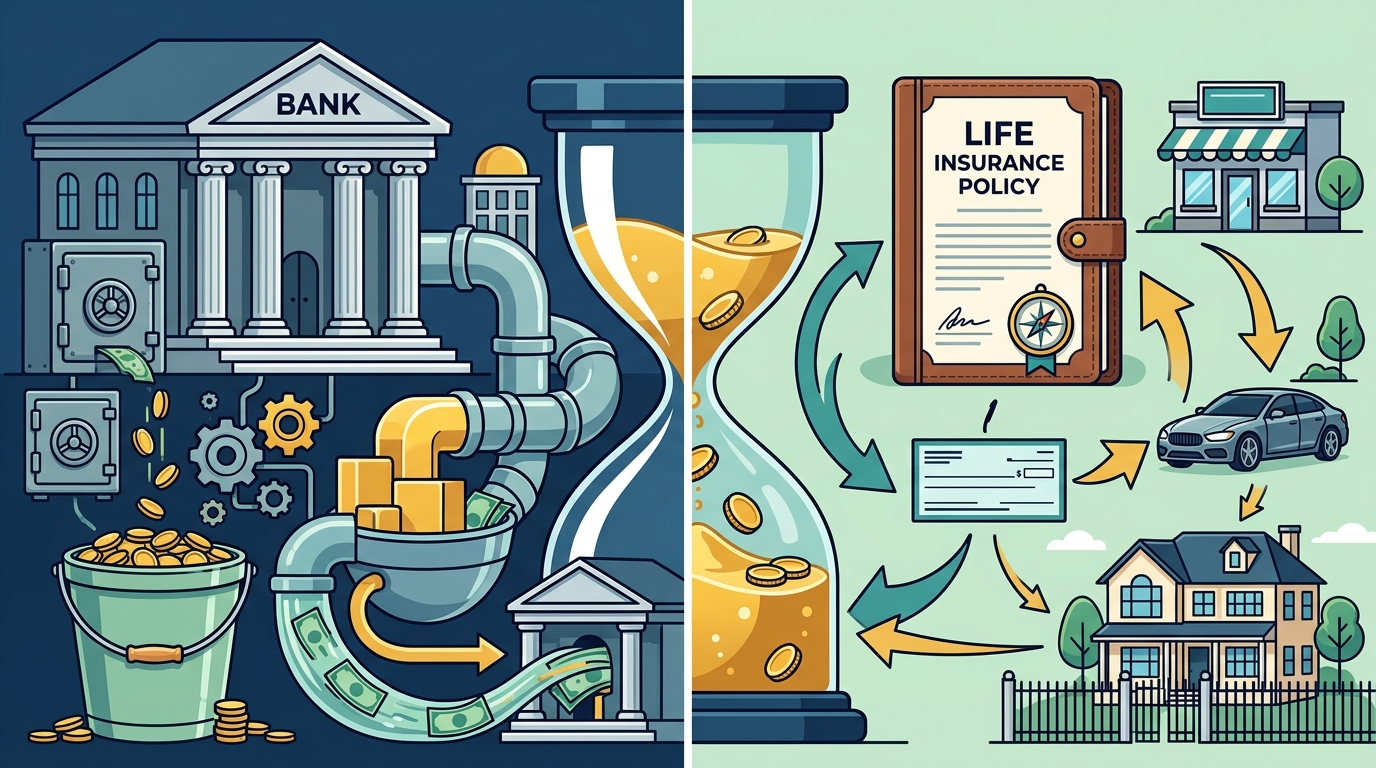
Traditional finance relies on a linear model of saving and borrowing. You deposit money into a savings account, earning minimal interest, and borrow from a bank for large purchases, paying high interest rates. This system separates your saving and borrowing activities, often resulting in a net loss of purchasing power due to inflation and interest rate differentials.
In this model, the bank retains the interest earned on your deposits while charging you more for loans. This spread is the bank's profit margin. While traditional banking offers liquidity and regulatory protection, it does not provide the leverage or tax advantages associated with privatized banking strategies.
Understanding the limitations of traditional savings is crucial. Our Financial Education Blog provides insights into why traditional savings accounts often fail to keep pace with inflation over long periods.
Key Differences in Wealth Accumulation
The fundamental difference lies in how capital is utilized. Privatized banking integrates your saving and borrowing, allowing you to use the same dollar for multiple financial purposes simultaneously. Traditional banking keeps these functions separate, often forcing you to choose between paying down debt or investing.
Another critical distinction is the tax treatment. Cash value growth within a permanent life insurance policy is tax-deferred. Loans against the policy are generally tax-free as long as the policy remains in force. In contrast, interest paid on traditional loans is rarely tax-deductible for personal expenses, and investment gains are subject to capital gains taxes.
We compare these outcomes in our Annuities for Retirement Income guide, which also explores how guaranteed income products can complement privatized banking strategies for retirement security.
Pros and Cons Analysis
Every financial strategy has trade-offs. Privatized banking offers significant control and potential for higher returns but requires upfront capital and policy management. Traditional banking offers ease of access but limits wealth acceleration potential.
| Feature | Privatized Banking | Traditional Banking |
|---|---|---|
| Interest Earned | Compound growth on cash value | Minimal savings account interest |
| Loan Interest | Paid to yourself (recaptured) | Paid to financial institution |
| Tax Efficiency | Tax-deferred growth, tax-free loans | Taxable investment gains |
| Liquidity | Subject to policy loans and surrender charges | High liquidity via checking/savings |
| Complexity | Requires strategic planning | Simple and straightforward |
For those interested in the specific mechanics of debt recapture, our About page details how Daniel Soto implemented these strategies to achieve financial independence.
Who Should Consider This Strategy?
Privatized banking is not for everyone. It is best suited for individuals with a stable income stream who can fund a permanent life insurance policy consistently. It is particularly effective for business owners, high-income professionals, and those looking to build a legacy of wealth.
If you are carrying high-interest debt, this strategy can help recapture that interest. However, it requires a long-term horizon to allow the policy to grow sufficiently. For immediate liquidity needs, traditional savings accounts remain more appropriate.
We offer specialized Disability Insurance and Life Insurance Solutions to protect the income streams that fund these strategies.
Key Takeaways
- Privatized banking uses whole life insurance cash value as collateral for loans.
- It allows you to recapture interest that would otherwise be paid to banks.
- The average American savings rate is approximately 6%, while debt interest costs are much higher.
- Cash value growth is tax-deferred, offering significant tax advantages.
- This strategy requires discipline and a long-term financial horizon.
- It is ideal for business owners and high-income professionals.
- Traditional banking offers liquidity but limits wealth acceleration potential.
Frequently Asked Questions
What is privatized banking?
Privatized banking is a strategy that uses a dividend-paying whole life insurance policy to create a private bank that you control, allowing you to finance investments or purchases while your cash value continues to grow.
How does it differ from traditional banking?
Traditional banking separates saving and borrowing, often resulting in net interest loss. Privatized banking integrates these functions, allowing you to pay yourself interest and retain tax-deferred growth.
Is privatized banking safe?
When structured correctly with a financially strong insurer, the cash value is guaranteed. However, it is a long-term strategy with surrender charges if exited early.
Who can benefit from this strategy?
Individuals with stable income, those seeking tax advantages, and business owners looking for flexible capital access can benefit significantly.
Can I use this for retirement?
Yes, many clients use privatized banking alongside Annuities for Retirement Income to create a diversified retirement plan.
How do I get started?
You can schedule a free strategy session to discuss your specific financial goals and see if this approach aligns with your needs.
What are the risks?
The primary risk is policy lapse if loans are not managed correctly. Proper structuring and monitoring are essential to maintain the strategy's benefits.
Start Your Financial Independence Journey
Take control of your financial future by exploring the power of privatized banking. Schedule a FREE Strategy Session today to discuss how this strategy can work for you. Contact us at (877) 323-8432 ext 800 or visit our Contact page for more information.