

Cost-Benefit Analysis: Professional Retirement and Insurance Planning
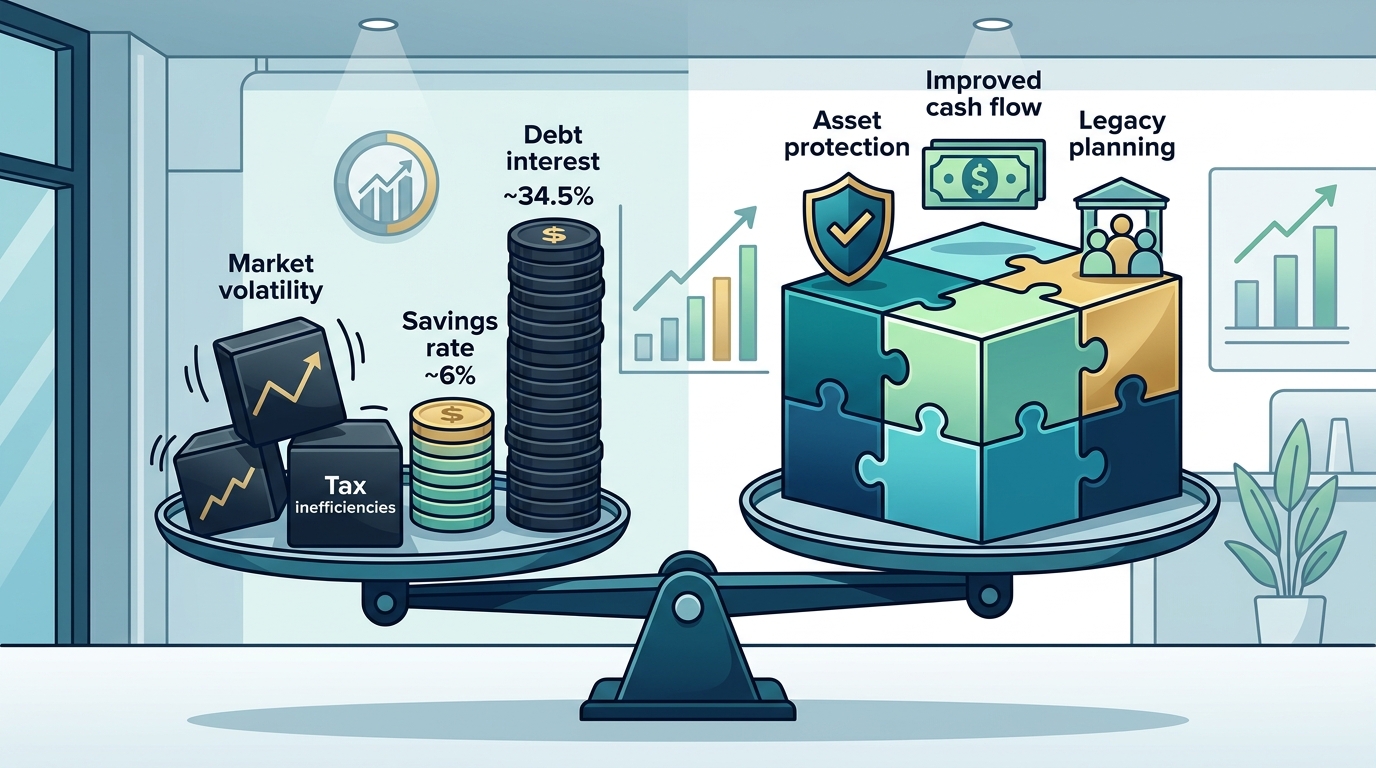
Traditional retirement planning often leaves families vulnerable to market volatility and tax inefficiencies. According to recent financial data, the average American savings rate hovers around 6% of earned income, while debt interest costs consume nearly 34.5% of financial resources. This disparity highlights the urgent need for strategic financial restructuring. By shifting from passive saving to active privatized banking strategies, individuals can recapture lost interest and build a self-sustaining financial engine. This guide analyzes the tangible costs and long-term benefits of integrating professional insurance planning into your retirement architecture. (Schedule a Financial Strategy)
Understanding the True Cost of Traditional Debt
Most individuals view debt as a necessary tool for acquiring assets like homes or vehicles. However, the financial cost extends far beyond the principal amount borrowed. When you finance a purchase through a bank, you are paying interest that could have been compounding within your own wealth structure. This is the core problem that Privatized Banking aims to solve.
The average American spends approximately 34.5% of their income on interest payments. This figure represents a massive leakage of wealth from your personal balance sheet to financial institutions. In contrast, the standard savings rate in America is only about 6%. This gap illustrates why traditional saving methods often fail to generate significant generational wealth. By continuing to pay interest to external lenders, you are effectively subsidizing their profits while your own net worth stagnates.
Professional planning begins with recognizing this leakage. It requires a shift in mindset from being a consumer of credit to becoming a provider of capital. This transition is not immediate, but the long-term benefits of recapturing that interest are substantial. The first step is understanding how permanent life insurance policies can serve as the foundation for a private banking system.
The Mechanics of Privatized Banking
Privatized Banking is a strategy that utilizes dividend-paying whole life insurance policies to create a personal "bank" that you control. This concept is not about replacing your primary bank entirely, but rather creating a parallel financial system for specific investments and large purchases.
Privatized Banking is a financial strategy where an individual uses a permanent life insurance policy as collateral to finance investments, allowing the policy's cash value to continue growing tax-deferred. This mechanism allows you to access capital without liquidating your assets or disrupting the compounding interest within your policy. When you take a loan against your policy, the cash value remains intact and continues to earn dividends or interest.
The process involves several key steps. First, you establish a robust whole life insurance policy with a focus on maximizing cash value accumulation. This policy acts as your private bank. Next, when you need capital for a real estate investment, a business venture, or a major purchase, you borrow against this cash value. The interest you pay on this loan goes back to your own policy, effectively paying yourself instead of a bank.
As you repay the loan, your policy's cash value increases further. Meanwhile, the underlying asset you purchased with the loan continues to generate its own returns. This dual-income stream is the primary benefit of the strategy. It allows you to leverage the power of compound interest on both your borrowed capital and your retained cash value.
Why Whole Life Insurance?
Whole life insurance is chosen for this strategy because of its guaranteed growth and dividend-paying structure. Unlike variable products, the cash value in a participating whole life policy offers a degree of predictability. This stability is crucial for a private banking system, where reliability is paramount. The policy is engineered to maximize cash value even while it is being used for personal financing.
Comparing Annuities vs. Life Insurance Strategies
Retirement planning often involves choosing between different financial instruments. Two common tools are annuities and whole life insurance policies. Both have distinct roles in a comprehensive financial plan. Understanding the differences is critical for making an informed cost-benefit analysis.
Annuities are primarily designed to provide guaranteed income streams in retirement. They protect against the risk of outliving your savings. Fixed indexed annuities, for example, offer interest based on market index performance without the risk of direct market loss. This makes them an excellent tool for creating a baseline of guaranteed lifetime income.
However, annuities are less flexible than life insurance policies when it comes to accessing capital during your working years. Whole life insurance offers liquidity and leverage capabilities that annuities typically do not match. This flexibility is why many professionals use both tools in tandem. The life insurance policy handles wealth accumulation and leverage, while the annuity handles income distribution in retirement.
| Feature | Whole Life Insurance (Privatized Banking) | Fixed Indexed Annuity |
|---|---|---|
| Primary Goal | Wealth Accumulation & Leverage | Guaranteed Retirement Income |
| Liquidity | High (via policy loans) | Low (surrender charges apply) |
| Growth Potential | Dividends + Cash Value Growth | Index-Linked Interest Caps |
| Tax Treatment | Tax-Deferred Growth & Tax-Free Loans | Tax-Deferred Growth |
| Best For | Business Owners & Investors | Retirees Seeking Stability |
Return on Investment Analysis
The cost-benefit analysis of professional retirement planning hinges on the concept of recapturing interest. When you use Privatized Banking to pay off high-interest debt, you are not just eliminating a liability. You are increasing your overall savings rate significantly. Some estimates suggest that by recapturing the interest you previously paid to banks, you could increase your savings rate by over 400%.
This metric is not just theoretical. It represents real cash flow that remains within your family's financial ecosystem. Instead of sending 34.5% of your income to interest payments, you are redirecting that capital into your private bank. This redirection creates a powerful compounding effect over time.
Furthermore, the tax advantages of these strategies cannot be overstated. Cash value growth in whole life policies is tax-deferred. Loans against the policy are generally tax-free as long as the policy remains in force. This contrasts sharply with taxable investment accounts, where capital gains and dividends are subject to annual taxation. The tax efficiency of Privatized Banking enhances the net return on investment, making it a superior vehicle for long-term wealth preservation.
Another critical benefit is the protection of assets. In an era of increasing litigation risks and economic uncertainty, having a protected asset class is vital. Life insurance cash value often enjoys strong creditor protection laws, depending on the state. This legal protection adds another layer of value to the cost-benefit equation.
Key Takeaways
- Interest Recapture: The average American spends 34.5% of income on debt interest. Privatized Banking allows you to recapture this by paying yourself instead.
- Savings Rate Impact: By shifting from debt payments to policy loans, individuals can potentially increase their effective savings rate by over 400%.
- Compound Interest: The wealthy utilize compound interest by ensuring their interest earns interest. Privatized Banking maintains this cycle even during borrowing periods.
- Strategic Use of Annuities: Fixed indexed annuities provide guaranteed income, while whole life insurance provides leverage and growth. Both are essential for a balanced plan.
- Tax Efficiency: Policy loans offer tax-free access to capital, unlike traditional investment withdrawals which may incur capital gains taxes.
- Professional Guidance: This strategy requires precise structuring. Working with a wealth coach like Daniel Soto ensures the policies are optimized for your specific cash flow needs.
- Generational Wealth: The ultimate goal is to create a financial legacy that can be passed down, protecting heirs from market volatility and debt.
Frequently Asked Questions
What is the primary difference between Privatized Banking and traditional investing?
Traditional investing involves buying assets like stocks or bonds, which carry market risk and tax liabilities. Privatized Banking uses a whole life insurance policy as a collateralized loan source, allowing your cash value to continue growing tax-deferred while you access capital. It focuses on recapturing interest rather than seeking high-risk market returns.
Is Privatized Banking suitable for everyone?
While the principles of saving and debt management apply to everyone, Privatized Banking is particularly effective for individuals with steady cash flow who can fund a permanent life insurance policy. It is often recommended for business owners, professionals, and those looking to build generational wealth rather than just short-term gains.
How do annuities fit into a Privatized Banking strategy?
Annuities are typically used for the retirement phase of the plan. Once wealth has been accumulated through Privatized Banking, annuities can be utilized to create a guaranteed lifetime income stream. This combination provides both growth during the accumulation phase and security during the distribution phase.
Can I use Privatized Banking to pay off my mortgage?
Yes, many clients use the cash value from their policies to pay off mortgages or other high-interest debts. By doing so, they stop paying interest to a bank and start paying interest to their own policy. This accelerates wealth building and reduces monthly financial stress.
What are the risks associated with Privatized Banking?
The primary risk is underfunding the policy or taking excessive loans that cause the policy to lapse. If a policy lapses, the tax advantages are lost, and the cash value may be subject to income tax. Proper structuring and professional oversight are essential to mitigate this risk.
How does Daniel Soto help with this process?
Daniel Soto, a retired chiropractor and wealth coach, specializes in implementing these strategies. He helps clients design plans that integrate whole life insurance and annuities to protect income and create guaranteed lifetime income. His approach is tailored to each family's unique financial goals and risk tolerance.
What is the minimum commitment required for this strategy?
Privatized Banking is a long-term strategy. It requires consistent premium payments over many years to build sufficient cash value. It is not a short-term investment vehicle but a lifelong financial framework designed to enhance your net worth over decades.
Start Your Financial Independence Journey
Understanding the cost-benefit analysis of professional retirement planning is the first step toward financial freedom. By leveraging the power of Privatized Banking and strategic annuity planning, you can take control of your financial future. Do not let interest payments drain your wealth. Instead, build a private bank that works for you.
Ready to explore how these strategies can benefit your family? Schedule a FREE Strategy Session with Daniel Soto today. Discover how to protect your income, create lifetime retirement paychecks, and build wealth with guarantees. Visit our About page to learn more about our mission and values. For more insights, explore our Financial Education Blog.