

Step-by-Step Guide to Building Tax-Efficient Retirement Income Through Privatized Banking
Traditional retirement planning often forces individuals to rely on volatile markets or tax-inefficient withdrawal strategies. Recent financial data indicates that the average American savings rate hovers around 6% of earned income, while debt interest costs consume nearly 34.5% of spending. This disparity highlights a critical gap in conventional wealth building. By shifting focus from passive saving to active capital management, individuals can construct a private financial infrastructure that protects principal and optimizes tax outcomes. This guide details the precise mechanics of using privatized banking to secure a reliable retirement income stream.
What Is Privatized Banking?
Privatized banking, often referred to as the Infinite Banking Concept, is a financial strategy that utilizes a specially designed whole life insurance policy to create a personal banking system. Privatized Banking is a method of using a dividend-paying permanent life insurance policy as collateral to finance investments or expenses while the cash value continues to grow. This approach allows individuals to act as their own banker, recapturing interest that would otherwise be paid to traditional financial institutions.
The core philosophy relies on the power of compound interest. When you deposit money into a traditional savings account, the bank lends that money out and pays you minimal interest. In a privatized banking model, you deposit premiums into a high-cash-value whole life policy. The insurance company invests these funds, and you receive dividends. When you need capital, you do not withdraw your cash value. Instead, you take a policy loan against it. This allows your cash value to continue growing as if the money were still there, while you access liquidity for other purposes.
For those seeking to understand the foundational principles of this strategy, Generational Wealth Concepts provides comprehensive resources on how to implement these strategies effectively. The goal is not merely to save money but to create a dynamic financial engine that supports both current needs and future legacy goals.
The Mechanics of Private Banking
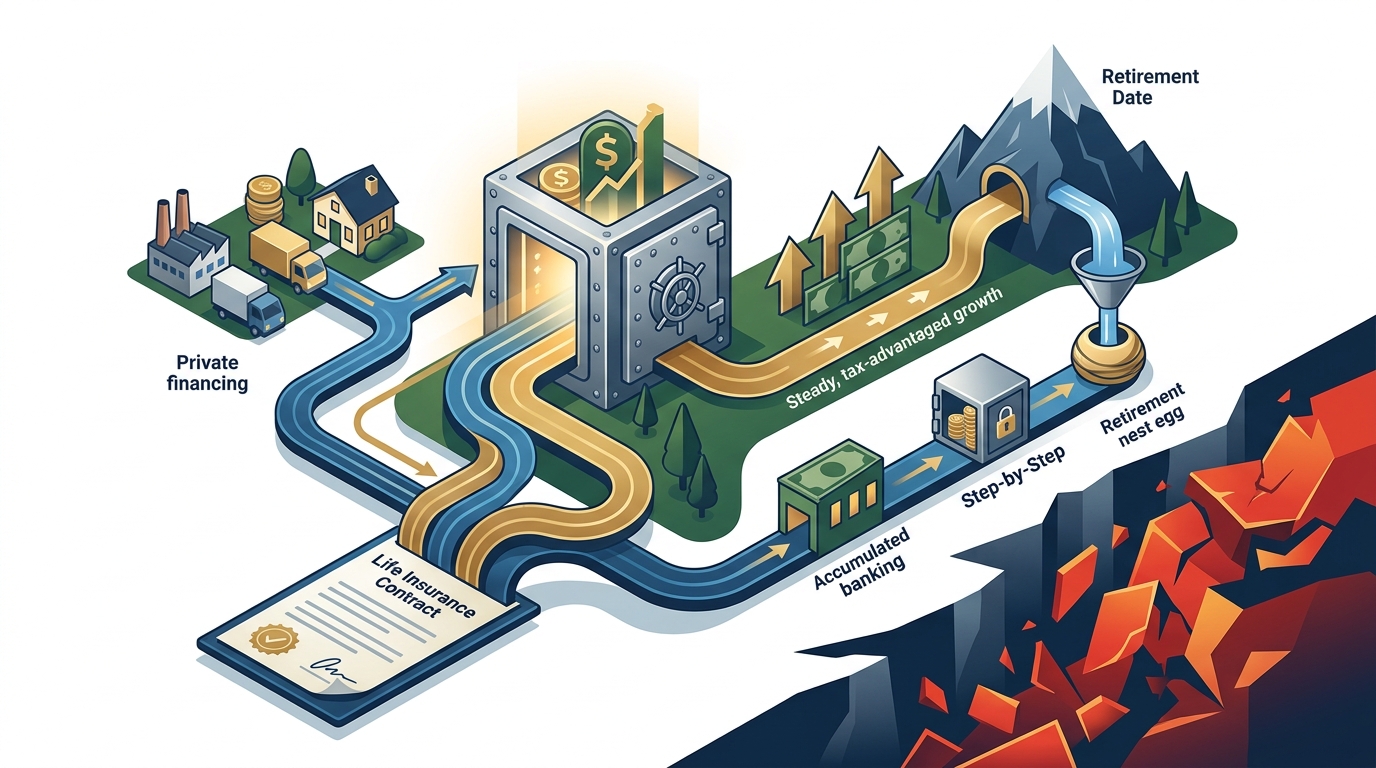
Understanding the operational mechanics is essential before implementing this strategy. The process begins with the acquisition of a participating whole life insurance policy. Unlike term insurance, which expires, whole life insurance provides lifelong coverage and accumulates cash value. The policy is designed to maximize cash value accumulation through paid-up additions and dividends.
Once the policy is established, it serves as a collateralized account. When you require funds for a real estate down payment, a business venture, or retirement income, you apply for a policy loan. The insurance company lends you money at a fixed interest rate. Crucially, you continue to pay interest on this loan, but that interest goes back into your own policy rather than to a bank. This recapture of interest is a primary driver of wealth accumulation.
The growth of the policy is guaranteed and tax-advantaged. Compound interest is the process where the principal investment gains interest, and then that interest earns additional interest over time. In the context of privatized banking, this compounding occurs uninterrupted because the cash value is not depleted by loans. This mechanism allows for exponential growth that outpaces traditional savings accounts, especially over long time horizons.
For a deeper dive into the specific insurance products that facilitate this strategy, explore our Insurance Services page. We offer tailored solutions that align with your financial capacity and long-term objectives.
Tax Advantages for Retirement Income
One of the most significant benefits of privatized banking is its tax efficiency. Traditional retirement accounts like 401(k)s and IRAs offer tax deferral, but withdrawals are taxed as ordinary income. Furthermore, required minimum distributions (RMDs) force withdrawals regardless of market conditions. Privatized banking offers a different tax profile that can complement traditional retirement accounts.
Policy loans are generally not considered taxable events. As long as the policy remains in force and is properly structured, the funds you borrow against your cash value are tax-free. This allows you to access retirement income without triggering immediate tax liabilities. Additionally, the cash value grows tax-deferred. You do not pay annual taxes on the dividends or interest earned within the policy.
When the policy is eventually surrendered or upon the death of the insured, the benefits are structured to minimize tax impact. Death benefits are typically income-tax-free to beneficiaries. For the policyholder, strategic withdrawals and loans can provide a steady stream of income that is largely insulated from market volatility and tax erosion. This makes privatized banking a powerful tool for preserving wealth across generations.
To understand how these tax benefits compare to other retirement vehicles, review our analysis of Annuities for Retirement Income. Both strategies offer guaranteed income, but they operate through different mechanisms and tax structures.
Step-by-Step Implementation
Implementing a privatized banking strategy requires careful planning and discipline. The following steps outline the process from initial consultation to active management.
Step 1: Assess Your Financial Capacity
Before initiating the strategy, evaluate your current financial health. Determine how much capital you can allocate to premium payments without compromising your emergency fund or daily expenses. Privatized banking is a long-term commitment. The policy needs time to build sufficient cash value to support meaningful loans. Daniel Soto, a retired chiropractor and wealth coach, emphasizes the importance of starting with a clear understanding of your cash flow and risk tolerance.
Step 2: Select the Right Policy Structure
Not all whole life policies are created equal. You need a policy designed for cash value accumulation. Work with a specialist to structure the policy with paid-up additions. These additional premiums buy extra shares of the policy, accelerating cash value growth. The goal is to maximize the cash value relative to the death benefit in the early years.
Step 3: Fund the Policy Consistently
Consistency is key. Make premium payments on time and as agreed. The policy's performance depends on the accumulation of cash value. Missing payments can reduce the policy's effectiveness or even cause it to lapse. Treat these payments as a non-negotiable expense, similar to a mortgage or utility bill.
Step 4: Utilize Policy Loans Strategically
Once the policy has built sufficient cash value, you can begin taking loans. Use these loans for investments that yield a return higher than the loan interest rate. For example, you might use a policy loan to purchase rental property. The rental income pays down the loan, while the policy continues to grow. Avoid using policy loans for depreciating assets or consumption.
Step 5: Monitor and Adjust
Regularly review your policy's performance. Ensure that the cash value is growing as projected. Adjust your loan usage and premium payments as your financial situation changes. If you experience a windfall, consider making additional paid-up additions to boost growth. For ongoing support and monitoring, Generational Wealth Concepts offers educational resources and updates on market trends.
Comparing Income Tools
While privatized banking is powerful, it is not the only tool for retirement income. Understanding the differences between available options is crucial for making an informed decision.
| Feature | Privatized Banking | Fixed Annuities | Stock Market Investments |
|---|---|---|---|
| Tax Treatment | Tax-deferred growth, tax-free loans | Tax-deferred, taxed upon withdrawal | Taxed on gains and dividends |
| Risk Profile | Low risk, guaranteed growth | Low risk, guaranteed income | High risk, market-dependent |
| Liquidity | High, via policy loans | Low, surrender charges apply | High, but market timing risk |
| Legacy Benefit | Tax-free death benefit | Optional death benefit | Market value at death |
| Control | Full control over capital | Limited control | Full control |
As noted in recent financial analyses, the average American spends a significant portion of income on debt interest. Privatized banking addresses this by recapturing that interest. For more insights on debt management, read our article on Disability Insurance and its role in protecting your income stream.
Key Takeaways
- Privatized banking uses whole life insurance to create a personal banking system for capital access.
- Policy loans allow access to cash value without triggering taxable events.
- Compound interest continues to grow the policy even when funds are borrowed against.
- Interest paid on policy loans is recaptured into your own policy, increasing net worth.
- Starting early maximizes the time value of money and cash value accumulation.
- Strategic use of policy loans can fund real estate or business ventures tax-efficiently.
- Generational Wealth Concepts provides specialized guidance for implementing these strategies.
Frequently Asked Questions
Is privatized banking suitable for everyone?
Privatized banking is best suited for individuals with a long-term financial horizon and the ability to make consistent premium payments. It is not a short-term investment vehicle. Those with high-interest debt may benefit from using the strategy to recapture interest, but it requires discipline.
How does the tax efficiency work?
The cash value grows tax-deferred. Loans against the policy are generally tax-free as long as the policy remains in force. This allows for tax-efficient access to retirement income without the penalties associated with early withdrawals from traditional retirement accounts.
What happens if I need to surrender the policy?
If you surrender the policy, you may receive the cash value minus any surrender charges. If the cash value exceeds the total premiums paid, the gain is subject to income tax. Proper planning ensures that the policy remains in force to maximize benefits.
Can I use privatized banking for business purposes?
Yes. Many business owners use privatized banking to finance business expansions, equipment purchases, or working capital. The flexibility of policy loans makes it a valuable tool for business liquidity.
How is this different from an annuity?
Annuities provide guaranteed income payments, while privatized banking provides access to capital that you manage. Annuities are often used for lifetime income guarantees, whereas privatized banking offers control over the timing and amount of withdrawals.
Who is Daniel Soto?
Daniel Soto is a retired chiropractor and wealth coach who has implemented privatized banking strategies to build financial independence. He now helps families and professionals design similar plans through Generational Wealth Concepts.
Where is Generational Wealth Concepts located?
Generational Wealth Concepts is based in Frisco, TX, and serves clients nationwide. You can contact them at https://genwealthconcepts.com/contact for more information.
Schedule Your Strategy Session
Building tax-efficient retirement income through privatized banking requires expert guidance and a customized plan. Generational Wealth Concepts offers free strategy sessions to help you understand how this powerful tool can fit into your financial picture. Contact us today to start your journey toward financial independence.
Schedule a FREE Strategy Session to discuss your goals and explore the potential of privatized banking for your retirement.