

Building a Four-Layer Disability and Long-Term Care Protection Plan for Small Business Owners
Small business owners face a unique financial paradox. You work harder than anyone else to build equity, yet your most valuable asset is your own earning capacity. According to recent industry data, approximately 40% of all disabilities affecting workers occur before age 65, and the average disability lasts nearly three years. For a business owner, a single health event can wipe out years of strategic planning in months. This is why a robust protection plan is not just an insurance product; it is a critical business continuity strategy.
Layer 1: Short-Term Income Replacement
The first layer of your defense is immediate cash flow preservation. When a business owner is injured or falls ill, the business does not stop running. Payroll, rent, and vendor payments continue regardless of your physical ability to work. Short-term disability insurance bridges this gap, typically covering 60 to 70% of your pre-tax income for a period of three to six months.
Without this layer, you are forced to dip into business reserves or personal savings to cover living expenses. This creates a dangerous precedent where you are paying yourself interest on money that could be compounding elsewhere. At Generational Wealth Concepts, we emphasize that protecting your immediate income stream is the foundation of all future wealth building. By securing short-term coverage, you ensure that your business operations remain stable while you recover.
Layer 2: Long-Term Disability Insurance
Short-term coverage is merely a bandage. The second layer addresses catastrophic scenarios where you cannot return to your profession for years, or ever. Long-term disability (LTD) insurance is designed to replace a significant portion of your income if you become permanently disabled. For a small business owner, this is often the most critical component of the plan because the loss of your active income is the primary threat to the business's viability.
Disability Insurance is a financial contract that provides income replacement if you are unable to work due to illness or injury. Unlike health insurance, which pays medical bills, LTD pays you directly. This distinction is vital. You need cash to pay your mortgage, fund your family's lifestyle, and keep the business afloat. We help professionals structure these policies to include disability income protection tailored for self-employed individuals, ensuring that the definition of disability aligns with your specific business role.
Layer 3: Long-Term Care Coverage
The third layer addresses a different type of risk: aging and chronic care needs. Long-Term Care (LTC) insurance covers the cost of assistance with daily living activities, such as bathing, dressing, or eating, if you become unable to perform them independently. This could result from a severe illness, accident, or cognitive decline like dementia.
Long-Term Care is specialized insurance designed to cover services that help with daily living activities when you are unable to perform them independently. The financial burden of LTC is staggering. Data from the Caring.com indicates that the national average cost for a private room in a nursing home exceeds $10,000 per month. For a small business owner, draining capital to pay for care can jeopardize the entire enterprise. By integrating LTC into your plan, you protect your business assets from being liquidated to pay for personal care.
Layer 4: Life Insurance and Privatized Banking
4.The final layer is often the most misunderstood but also the most powerful. This involves using a dividend-paying whole life insurance policy not just for death benefit protection, but as a financial engine. This is the core of the privatized banking strategy taught by Daniel Soto and the team at Generational Wealth Concepts.
Privatized Banking is a financial strategy that uses a permanent life insurance policy as a personal bank, allowing you to borrow against your cash value for investments or debt repayment while the policy continues to grow. When you are healthy, you maximize the cash value of this policy. If you face a disability, the policy can provide a living benefit. If you pass away, it provides liquidity for your business succession.
This layer creates a self-sustaining loop. You use the policy to finance business growth, and the business growth funds the policy premiums. This approach allows you to build wealth with guarantees while maintaining liquidity. It transforms your insurance from a passive expense into an active asset that works for you 24/7.
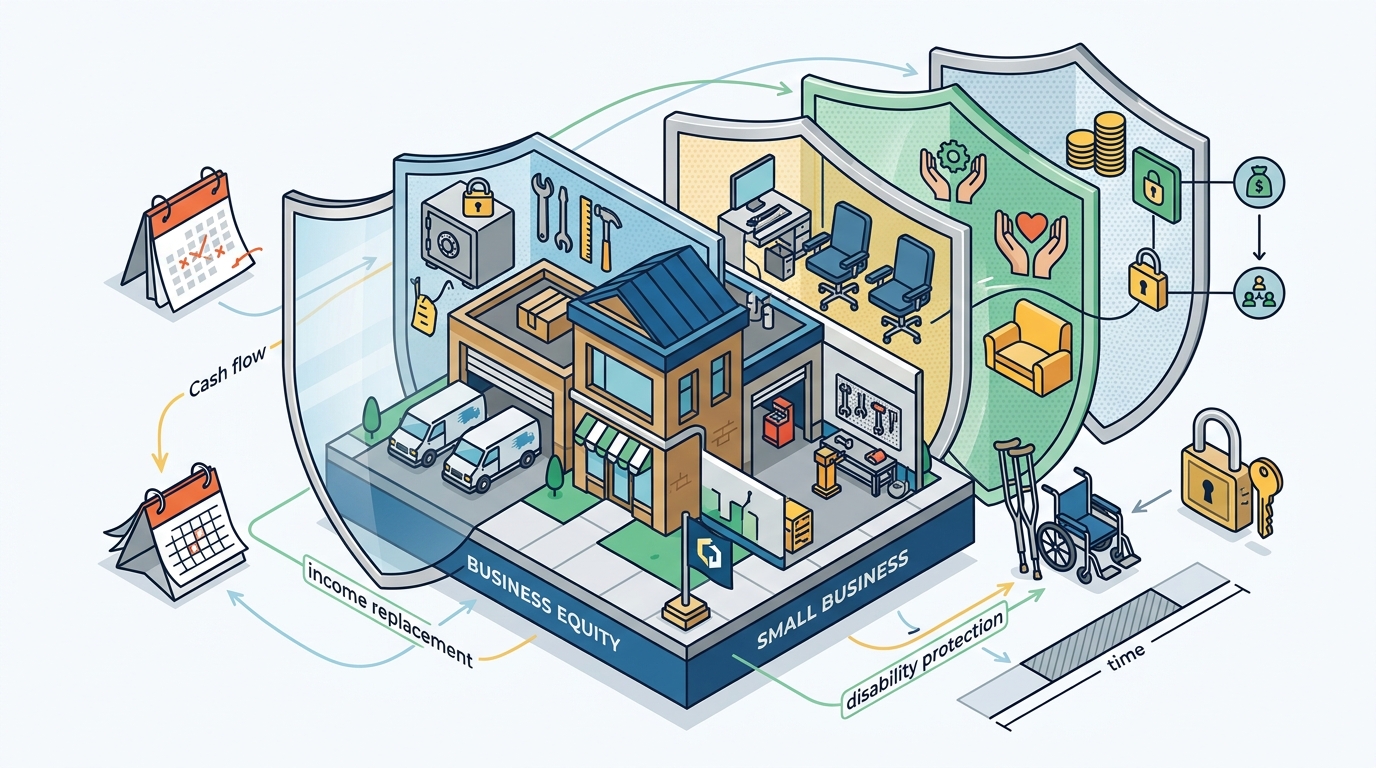
Comparing Protection Strategies
Understanding how these layers interact is crucial for effective planning. The table below outlines the primary function and benefit of each component in your four-layer plan.
| Protection Layer | Primary Function | Key Benefit for Business Owners | Typical Duration |
|---|---|---|---|
| Short-Term Disability | Immediate income replacement | Covers payroll and expenses during recovery | 3 to 6 months |
| Long-Term Disability | Catastrophic income protection | Replaces income if you cannot return to work | Until retirement age |
| Long-Term Care | Chronic care cost coverage | Prevents asset liquidation for care costs | As needed |
| Whole Life / Privatized Banking | Wealth accumulation and liquidity | Provides loans and death benefit liquidity | Lifetime |
Each layer serves a distinct purpose. Relying on just one leaves gaps. For example, disability insurance does not cover care costs, and life insurance does not replace income while you are alive. A comprehensive plan integrates all four to create a seamless safety net.
Key Takeaways
- Income is your primary asset: For small business owners, the loss of earning capacity is more financially damaging than the loss of physical assets.
- Short-term gaps are dangerous: Without short-term disability, you may deplete emergency funds within weeks of an injury.
- Privatized banking adds liquidity: Using whole life insurance as a collateral source allows you to access capital without surrendering the policy's growth potential.
- LTC protects business equity: Dedicated long-term care coverage prevents the need to sell business assets to pay for personal care.
- Integration is key: The most effective plans coordinate disability, LTC, and life insurance to work in tandem, not in isolation.
- Early planning reduces costs: Health and age are the primary drivers of premium costs. Securing coverage while healthy locks in lower rates.
- Professional guidance is essential: Navigating the nuances of self-employed disability policies requires expertise to ensure adequate coverage limits.
Frequently Asked Questions
How much disability insurance does a small business owner need?
Most experts recommend replacing 60% to 80% of your pre-tax income. This ensures you can maintain your lifestyle and business obligations without facing a significant drop in standard of living.
Can I use life insurance to cover disability expenses?
While life insurance is primarily for death benefits, many whole life policies include a living benefit rider that allows you to access the death benefit early if you are diagnosed with a terminal or chronic illness.
What is the difference between short-term and long-term disability?
Short-term disability covers immediate income loss for a few months, while long-term disability kicks in after the short-term period ends and can provide income for years or until retirement.
How does privatized banking help with business continuity?
Privatized banking allows you to borrow against your policy's cash value to fund business operations or personal expenses during a disability, keeping your cash flow healthy without disrupting your investment growth.
Is long-term care insurance necessary if I have savings?
Even substantial savings can be depleted quickly by care costs. LTC insurance provides a dedicated pool of funds that cannot be touched by other business or personal liabilities, ensuring your care is paid for without risk to your business.
What is the average cost of long-term care in the US?
According to data from the Society of Actuaries, the average annual cost for a nursing home can exceed $100,000, while home health care averages around $60,000 annually.
How do I start building a four-layer protection plan?
Start by assessing your current income, business expenses, and existing assets. Then, consult with a financial strategist to design a plan that integrates disability, LTC, and life insurance components tailored to your specific risk profile.
Schedule Your Strategy Session
Building a four-layer protection plan is not a DIY project. It requires precise coordination between your business goals and your personal risk tolerance. At Generational Wealth Concepts, we help you design a plan that protects your income, your business, and your legacy.
Do not wait for a crisis to test your financial resilience. Take control of your future today. Schedule a free strategy session with Daniel Soto and our team to explore how privatized banking and comprehensive insurance can secure your financial independence.