

Common Pitfalls in Privatized Banking Setup and How to Avoid Them
Privatized banking, often referred to as Infinite Banking, has gained significant traction among high-net-worth individuals and business owners seeking liquidity and control over their capital. According to recent industry analyses, the adoption of whole life insurance strategies for banking purposes has grown steadily as traditional banking margins tighten. However, the complexity of these structures means that improper implementation can lead to severe financial consequences. This guide outlines the critical pitfalls in setting up a privatized banking system and provides actionable strategies to ensure your financial independence remains intact. (Contact Generational Wealth Concepts)
Understanding the Basics of Privatized Banking
Before diving into the pitfalls, it is essential to define the core mechanism. Privatized Banking is a financial strategy that uses the cash value of a whole life insurance policy as a personal banking system. This concept allows individuals to borrow against their policy's cash value for investments, real estate, or business ventures, rather than relying on traditional bank loans.
The strategy relies on the policy's ability to grow tax-deferred while providing liquidity. When you borrow against your policy, you do not trigger a taxable event. Furthermore, the cash value continues to grow as if the loan were not there, provided you pay interest back to your own policy. This creates a circular flow of capital that can accelerate wealth accumulation. However, the success of this strategy depends entirely on the structural integrity of the policy and the discipline of the user.
Pitfall 1: Incorrect Funding and Overfunding
One of the most common errors in setting up a privatized banking system is improper funding. Many individuals either underfund their policies, rendering them ineffective, or overfund them, triggering unwanted tax consequences.
The MEC Trap
A Modified Endowment Contract (MEC) occurs when you pay more into a life insurance policy than the IRS allows in a given year. A MEC is a policy that has been overfunded beyond IRS limits, causing it to lose its favorable tax treatment. Once a policy becomes a MEC, loans and withdrawals are taxed on a Last-In, First-Out (LIFO) basis, and early withdrawals may incur a 10% penalty. This completely undermines the tax-advantaged nature of the strategy.
Underfunding Risks
Conversely, underfunding leads to a policy that lacks sufficient cash value to support meaningful loans. If the cash value is too low, the policy may lapse if premiums are not maintained, resulting in a taxable event for the entire gain. It is crucial to calculate the maximum non-MEC premium based on your age, gender, and financial goals.
Pitfall 2: Poor Policy Design and Illustration Errors
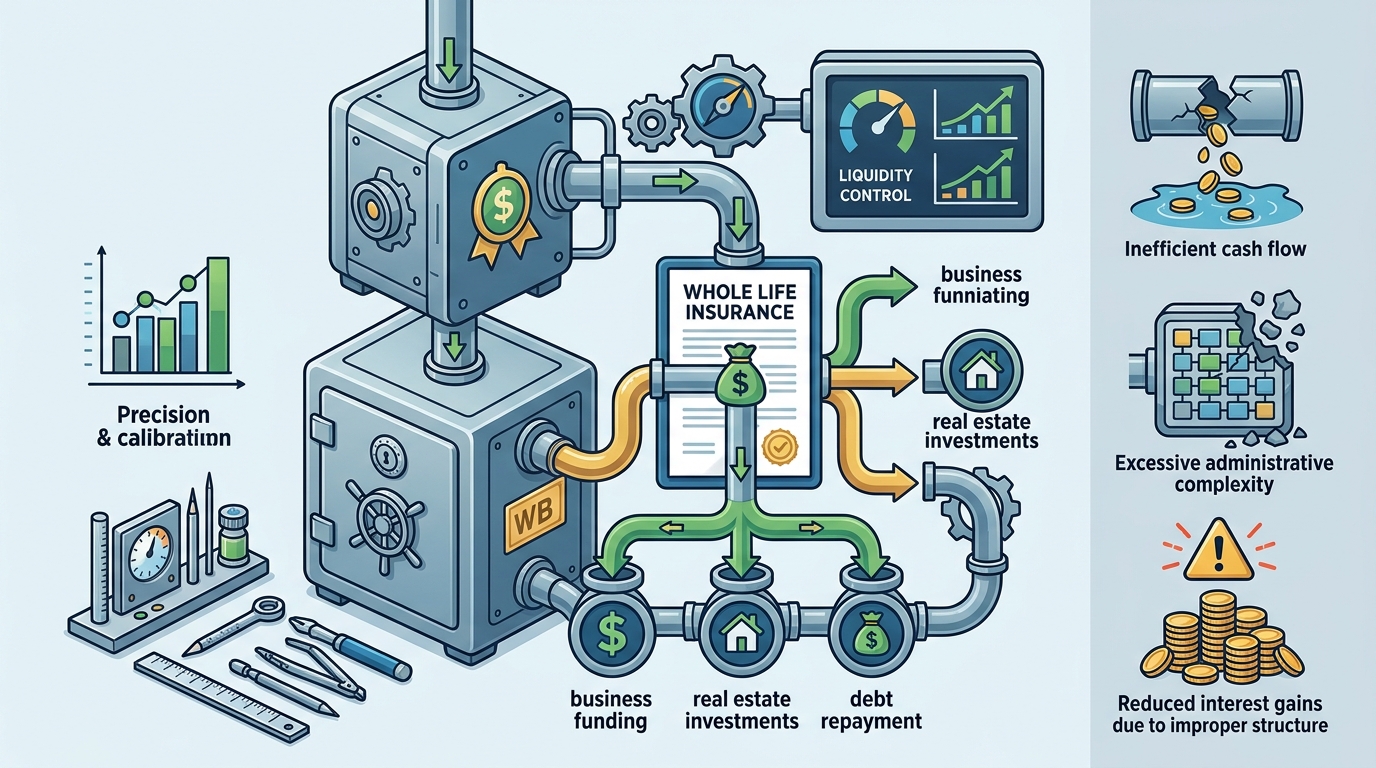
The design of the whole life policy is the engine of your privatized banking system. A poorly designed policy will fail to generate the cash value growth necessary to support your banking activities.
Guaranteed vs. Non-Guaranteed Dividends
Illustrations often show two columns: guaranteed and non-guaranteed. Many clients focus solely on the non-guaranteed projections, which assume high dividend rates. If the insurance company's performance declines, the policy may not have enough cash value to cover premiums or loans. Always review the guaranteed column to ensure the policy remains viable in worst-case scenarios.
Cost of Insurance (COI) Increases
As you age, the cost of insurance increases. A policy designed without accounting for future COI increases may become unaffordable. Ensure your policy is designed to be self-sustaining or has enough excess cash value to absorb these increases without lapsing.
Pitfall 3: Ignoring Liquidity and Loan Risks
While privatized banking offers liquidity, it is not without risks. The most significant risk is the potential for policy lapse due to unpaid loans.
Loan Interest Rates
When you borrow against your policy, you must pay interest. If the interest rate is too high, or if you fail to pay it, the loan balance will grow and eat into your cash value. This can lead to a death benefit reduction or a policy lapse. It is essential to understand the loan interest rate structure and have a plan for repayment.
Market Correlation
While whole life insurance is not directly tied to the stock market, the broader economy affects insurance company performance. If the economy enters a recession, insurance companies may reduce dividend rates. This can impact the growth of your cash value, making it harder to sustain loans. Diversification and conservative planning are key to mitigating this risk.
Pitfall 4: Overlooking Tax Implications
Tax efficiency is a primary benefit of privatized banking, but it is not absolute. Misunderstanding the tax rules can lead to unexpected liabilities.
Policy Lapse and Taxable Events
If your policy lapses or is surrendered, and the cash value exceeds the total premiums paid, the gain is taxable as ordinary income. This is a catastrophic outcome for a wealth-building strategy. Regular monitoring of the policy's status is essential to prevent this.
Estate Tax Considerations
For high-net-worth individuals, the death benefit of a life insurance policy may be included in your taxable estate. This can create a liquidity crunch for your heirs. Using an Irrevocable Life Insurance Trust (ILIT) can help remove the policy from your estate, but it adds complexity to the setup.
Pitfall 5: Neglecting Insurer Stability
The safety of your privatized banking system depends on the financial strength of the insurance company issuing the policy. Unlike bank deposits, life insurance policies are not FDIC insured.
Financial Strength Ratings
Always choose an insurance company with high financial strength ratings from agencies like A.M. Best, Standard & Poor's, and Moody's. A strong rating indicates the company's ability to meet its long-term obligations, including dividend payments and death benefits.
Dividend History
Review the company's dividend history over the past 10-20 years. A consistent dividend record suggests stability and reliability. Avoid companies with volatile or declining dividend trends, as this can impact the growth of your cash value.
Key Takeaways
- Avoid MEC Status: Never exceed IRS premium limits to maintain tax-advantaged status.
- Design for Guarantees: Base your strategy on guaranteed cash value, not optimistic projections.
- Monitor Loans: Ensure loan interest is paid to prevent cash value erosion.
- Check Ratings: Only use insurance companies with A.M. Best ratings of A- or higher.
- Understand Taxes: Be aware of the tax implications of lapses and surrenders.
- Plan for COI: Account for increasing cost of insurance as you age.
- Seek Professional Help: Work with a fiduciary who understands privatized banking.
Frequently Asked Questions
What is the difference between privatized banking and traditional banking?
Privatized banking uses the cash value of a whole life insurance policy as a source of loans, allowing you to borrow against your own money while it continues to grow. Traditional banking involves borrowing from a third party, paying interest to them, and having no ownership stake in the loan's collateral.
Can I lose my privatized banking policy?
Yes, if you fail to pay premiums or if loans exceed the cash value, the policy can lapse. A lapse results in a taxable event and loss of coverage. Regular monitoring and conservative loan-to-value ratios are essential to prevent this.
Is privatized banking suitable for everyone?
No, it is best suited for individuals with a long-term horizon, stable income, and a need for liquidity. It is not a short-term investment vehicle and requires discipline to manage effectively.
How do I avoid a Modified Endowment Contract (MEC)?
You can avoid a MEC by staying within the IRS premium limits for your age and gender. A financial advisor can calculate the maximum non-MEC premium for your specific situation.
What happens if the insurance company goes bankrupt?
While rare, if an insurance company fails, state guaranty associations provide coverage up to certain limits. Choosing a financially strong company minimizes this risk significantly.
Can I use privatized banking for retirement?
Yes, many individuals use privatized banking as a supplement to retirement income. Loans can be taken tax-free, and the death benefit can provide legacy planning.
How much cash value do I need to start?
The amount depends on your financial goals. Generally, a policy needs to be funded sufficiently to generate meaningful cash value within a few years. A common starting point is a policy with a face amount that allows for substantial cash value accumulation.
Schedule Your Strategy Review
Setting up a privatized banking system is a complex process that requires careful planning and execution. At Generational Wealth Concepts, we help individuals, families, and business owners design strategies for retirement income, protection, and legacy. Our team coordinates with specialized professionals to ensure your plan is robust and tailored to your needs.
Do not let common pitfalls derail your financial independence. Schedule a free strategy session with Daniel Soto and his team to review your current position and explore how privatized banking can fit into your broader financial plan.
Schedule a FREE Strategy Session today to take the first step toward financial confidence.