
What Happens to Your Business Debt if You Suddenly Can't Work?
If you suddenly cannot work due to illness or injury, your business debt does not disappear. Lenders will continue to demand payments, and your personal assets may be at risk if you are personally liable. Without a specific income replacement strategy, you may be forced to sell assets or default on loans. Disability insurance is the primary tool used to bridge this gap and protect your business obligations.
The Immediate Financial Shock of Sudden Disability
When a business owner stops working, the cash flow engine of the company shuts down. However, the fixed costs of running a business, including debt service, remain unchanged. This creates an immediate liquidity crisis. Business debt is a financial obligation that must be met regardless of the owner's physical ability to generate revenue. If you are the sole income earner, your personal savings become the first line of defense against missed payments.
Most business owners underestimate the duration of a disability. While some injuries heal in weeks, chronic illnesses or severe accidents can prevent work for months or years. During this period, your personal income stops, but your mortgage, car loans, and business lines of credit continue to accrue interest. The gap between your stopped income and your ongoing debt obligations is where financial ruin often begins.
Personal Liability and the Corporate Veil
Many small business owners operate as sole proprietors or single-member LLCs. In these structures, there is often no legal distinction between the owner and the business. This means that personal liability is a direct risk. If you sign a business loan with a personal guarantee, your personal assets, including your home and savings, are on the hook for the debt.
Even in corporate structures, lenders frequently require personal guarantees for small business loans. This legal requirement means that if the business cannot pay, the lender can pursue you personally. Understanding your specific liability is the first step in protecting your wealth. You must know exactly which debts are tied to your personal credit and which are strictly business obligations.
Types of Business Debt at Risk
Not all business debt is treated the same way during a disability event. The following table outlines common debt types and their typical risk profiles for a disabled owner.
| Debt Type | Typical Personal Liability | Risk During Disability |
|---|---|---|
| SBA Loans | Personal Guarantee Required | High risk to personal assets |
| Business Credit Cards | Often Personally Guaranteed | High risk, rapid interest accrual |
| Equipment Financing | Asset Secured | Asset seizure if payments stop |
| Commercial Real Estate | Personal Guarantee Common | High risk, complex foreclosure |
The Role of Disability Income Insurance
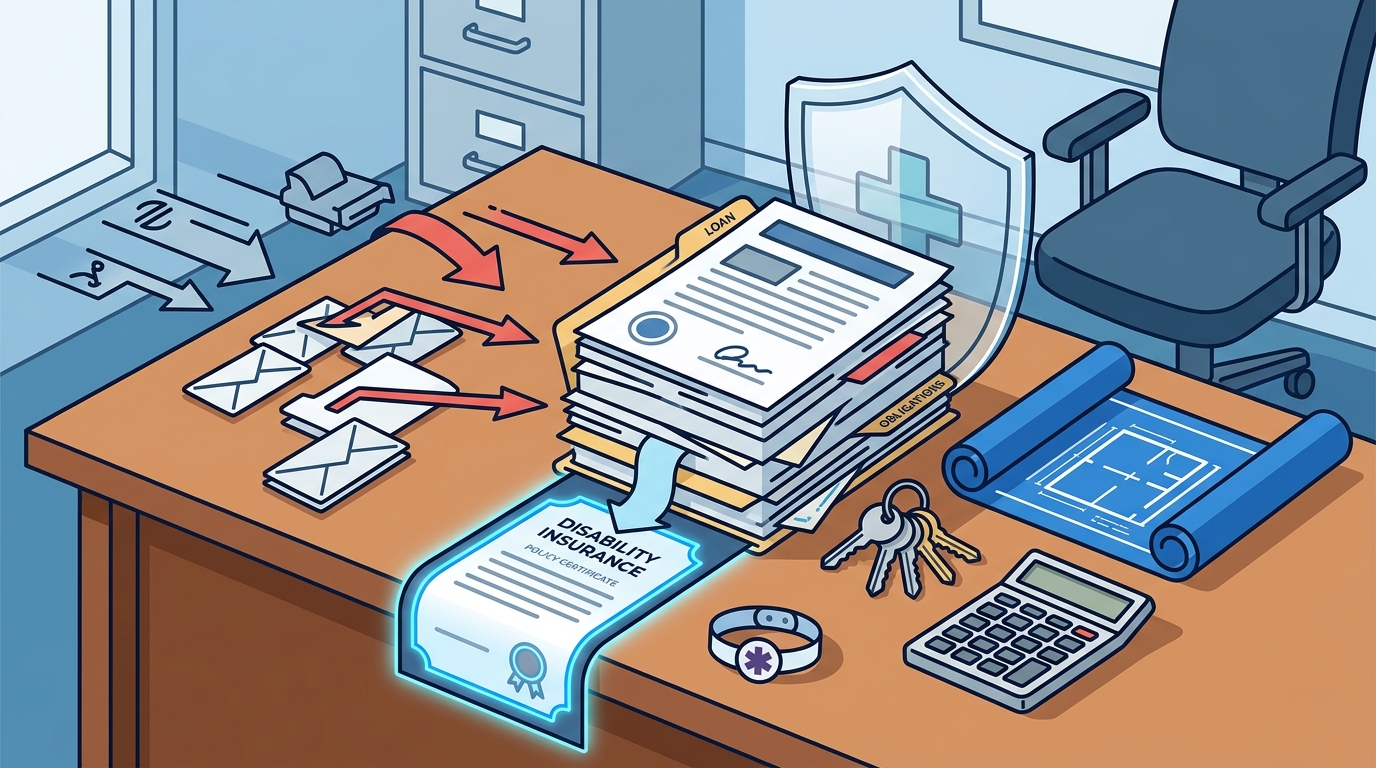
Disability income insurance is a contract that replaces a portion of your income if you become unable to work due to illness or injury. For business owners, this is not just a personal benefit; it is a business continuity tool. By replacing your income, you maintain the cash flow needed to service business debt.
There are two main types of coverage to consider: short-term and long-term. Short-term disability typically covers 3 to 6 months. Long-term disability can provide benefits for years, or even until retirement age. For a business owner with significant debt, long-term coverage is often essential. It ensures that your debt service payments continue for the duration of your recovery, not just for a few months.
Own-Occupation Coverage
For professionals and business owners, own-occupation coverage is a critical feature. This type of policy pays benefits if you cannot perform the specific duties of your own job, even if you could perform other types of work. For example, a chiropractor who cannot stand for long periods may still be able to do administrative work, but an own-occupation policy would still pay benefits because they cannot practice chiropractic care.
Protecting Cash Flow and Business Continuity
Protecting your business debt is about more than just paying the minimum. It is about maintaining the operational stability of your company. If you stop paying your business loans, your credit score will drop, and your business credit will be damaged. This can make it impossible to access emergency funding or refinance existing debt. according to Bankruptcy Statistics Updated
Disability insurance provides a predictable monthly income. This predictability allows you to budget for debt service without dipping into emergency reserves. It also allows you to continue paying your employees, which is crucial for maintaining customer relationships and business reputation. A business that continues to operate, even at a reduced capacity, is far more likely to survive a disability event than one that shuts down.
Strategies for Managing Debt During Recovery
If you are already disabled, you may need to take immediate steps to manage your debt. First, contact your lenders to explain your situation. Many lenders have hardship programs that can temporarily reduce payments or defer interest. However, these are not guaranteed, and they may not cover the full duration of your disability.
Second, review your insurance policies. You may have existing coverage through your employer or a personal policy that you have not fully utilized. Third, consider selling non-essential assets to free up cash flow. Finally, consult with a legal professional to understand your specific liability and options. The goal is to protect your personal assets while keeping your business afloat.
Key Takeaways
- Business debt does not disappear when you become disabled; lenders will continue to demand payments.
- Personal guarantees on business loans put your personal assets at risk.
- Disability income insurance is the primary tool for replacing income and servicing debt.
- Own-occupation coverage is essential for professionals and business owners.
- Long-term disability coverage is often necessary for owners with significant debt.
- Proactive planning is far more effective than reactive measures after a disability event.
Frequently Asked Questions
Does disability insurance cover business debt?
Disability insurance does not pay your business debt directly. Instead, it replaces your income, which you can then use to make debt payments. The key is to have enough coverage to meet your monthly debt obligations.
What is the difference between short-term and long-term disability?
Short-term disability covers a brief period, usually 3 to 6 months. Long-term disability covers a longer period, potentially years or until retirement. Business owners with significant debt often need both.
Can I get disability insurance if I am self-employed?
Yes, self-employed individuals can purchase disability insurance. However, underwriting may be more complex, and premiums may be higher. It is important to work with an independent agent who understands the specific needs of business owners.
What is own-occupation coverage?
Own-occupation coverage pays benefits if you cannot perform the specific duties of your own job, even if you could do other work. This is a premium feature that is highly valuable for professionals.
How much disability insurance do I need?
You should aim to replace enough income to cover your essential expenses, including business debt service. A common guideline is to replace 60% to 70% of your pre-disability income, but this varies by individual circumstances.
Will disability insurance affect my business credit?
Disability insurance itself does not affect your business credit. However, if you use the insurance benefits to make timely debt payments, it can help protect your credit score and business credit standing.
Can I use disability insurance benefits to pay off my business?
You can use the benefits for any purpose, including paying off business debt. However, it is generally better to use the benefits to cover ongoing expenses and debt service, rather than paying off debt in full, unless the debt is high-interest and unsecured.
Protect Your Business and Your Future
Your business is a major asset, and your ability to work is the engine that drives it. Protecting that engine is essential for protecting your debt and your legacy. Generational Wealth Concepts helps business owners and professionals design disability income strategies that protect their income, their business, and their family. We work with you to understand your specific risks and liabilities, and we help you find the right coverage to bridge the gap between your stopped income and your ongoing obligations. Schedule a free strategy session to discuss how to protect your business debt and your financial future.